
Access the full report
Socioeconomic Impact of Disease in LATAM
June 13, 2024 La Federación Latinoamericana de la Industria Farmacéutica (FIFARMA), en colaboración con el instituto alemán de investigación económica WifOR, presented a report that evaluates the social and economic impact of seven diseases in eight Latin American countries.
The study estimates the cost of productivity losses and economic impacts resulting from these diseases in Argentina, Brazil, Chile, Colombia, Costa Rica, Ecuador, Mexico and Peru. The diseases studied include cardiovascular diseases, neoplasia, ischemic heart disease, type 2 diabetes, lower respiratory infections, breast cancer and migraine.
To determine the socioeconomic impact of diseases, the study considers two scenarios. First, the human capital approach, where the irreplaceable loss of an individual's productivity is assumed when dying prematurely, and the second scenario, the friction cost approach, where, within a year, the deceased's tasks are taken over by another individual or technology. Under this second assumption, the social and economic cost of diseases represented on average 3.5% of each country's GDP in 2022.
The study states that during the period 2018-2022, Latin American economies stopped producing 895 billion dollars due to productivity losses caused by these diseases, which represents USD 2,145 per capita. This implies that all those over 15 years of age would have to work 10.3 more days to compensate for these productivity losses.
The results of this study propose a paradigm shift where the health budget is not considered an expense, but a crucial investment for economic growth, prosperity, innovation and social well-being, understanding that the burden of disease not only affects individuals who suffer from it, but also has repercussions at a social and economic level, impacting labor productivity, health care costs and the quality of life of the population.
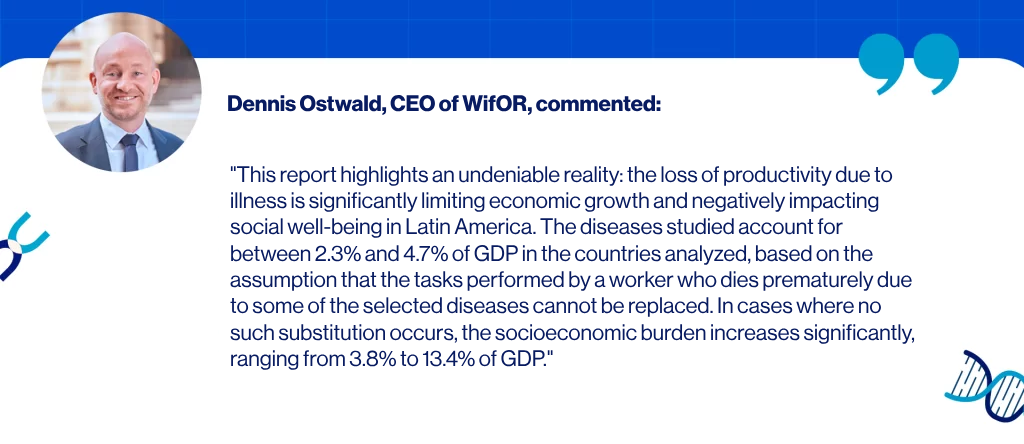
Additionally, the most significant socioeconomic burden comes from neoplasia and cardiovascular diseases, which represent around 18.5% and 17.6% of GDP respectively, with Argentina, Brazil and Chile being the most affected countries. Meanwhile, type 2 diabetes mellitus and migraine are the two diseases that, according to the study, cause the greatest loss of productivity associated with years lived with disability.
This report offers key recommendations for public sector decision-makers. A multidimensional approach combining effective public policies and intersectoral collaboration is essential. The key is to strengthen local data collection to design precise interventions, develop prevention and education programs tailored to specific sectors, facilitate access to innovative treatments, and establish continuous monitoring mechanisms. These actions will not only mitigate the economic and social impact of the diseases, but will also promote more sustainable and equitable development in the region.
Yaneth Giha, Executive Director of FIFARMA concluded: “All actors in the health sector must work together to reduce these effects in countries. Robust public policies are needed, including preventive and educational actions, as well as effective access to innovative treatments. Investing in health is vital, as it not only reduces long-term costs, but also contributes to economic growth and social development.“
Learn more about the study at the following link:
Contacto de prensa. Santiago Jimenez
Sjimenez@fifarma.org